
Multiple inverter blocks
Two-, three-, and five-winding configurations support different plant architectures. Dedicated HV–LV pairing helps manage impedance and mechanical balance.
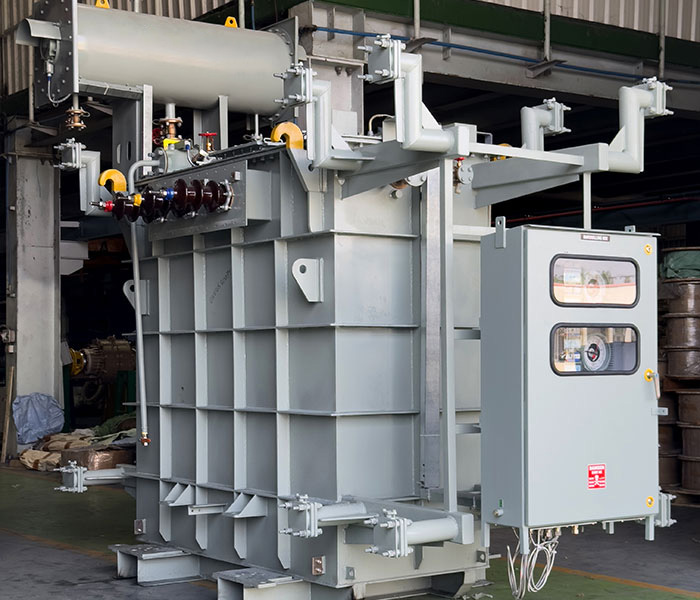
Select a photo to explore. Open the main image for a full-size view.
Renewable energy integration
Solar inverter-duty transformers engineered for PV generation, voltage ripple, harmonics, and grid integration. Turnix supports 2-winding designs up to 7.5 MVA, 3-winding designs up to 10 MVA, and 5-winding designs up to 20 MVA, with application-specific winding and insulation configurations.
Turnix technical capabilities
Explore the portfolio and configuration options. Turnix’s technical team will help align the equipment with your application, site, and performance requirements.
Match the winding arrangement to the inverter blocks and the plant’s electrical design.
| Parameter | Turnix capability |
|---|---|
| 2-winding configuration | Up to 7.5 MVA |
| 3-winding configuration | Up to 10 MVA |
| 5-winding configuration | Up to 20 MVA |
| Primary voltage class | Up to 34.5 kV |
| Custom HV / LV voltage configurations | Tailor-made configurations up to 33 kV; specify required ratio |
| LV winding | Foil-wound construction |
| Voltage ripple capability | Insulation optimized for ripple up to 2.0 kV |
| Rate of voltage change | Insulation optimized for du/dt up to 1 kV/µs |
| Winding design | Dedicated HV–LV winding pairing for impedance control and mechanical balance |
| EMI shielding | Shielding options available to suit the inverter and project requirements |
| Standards references | IS 2026; IEC 60076; IEEE C57.12.00 for applicable liquid-immersed designs; IEEE C57.159 photovoltaic application guide |
The primary voltage class and custom winding voltages are distinct selection fields. Turnix reviews the required ratio, winding count, inverter data, and insulation duty together.
Design & configuration
Electrical, mechanical, and installation requirements come together in the selected Turnix solution.
Two-, three-, and five-winding configurations support different plant architectures. Dedicated HV–LV pairing helps manage impedance and mechanical balance.
Foil-wound low-voltage windings support uniform current distribution and short-circuit withstand capability within the selected design. EMI-shielding options can be coordinated with the inverter system and plant requirements.
Insulation design addresses voltage ripple up to 2.0 kV and du/dt up to 1 kV/µs. Submit the inverter duty and waveform requirements for coordinated review.
Testing & documentation
Design and testing requirements are selected from IS 2026, IEC 60076, and IEEE C57.12.00 where applicable to the transformer construction. IEEE C57.159 provides photovoltaic application guidance. Applicable editions and the agreed test scope are identified in the project submittal.
Review the inverter datasheet, load profile, harmonic spectrum, winding allocation, and thermal requirements before finalizing the transformer schedule.
Agree losses, impedance, insulation duty, factory tests, and grid interfaces, supported by drawings and operating documentation for the selected design.
Turnix coordinates the technical submittals and deliverables needed for equipment review, delivery, and operation.
Prepare your RFQ
Share the application, electrical duty, and site requirements. We’ll help turn them into a clear equipment scope.
Inverter datasheet, power block arrangement, AC voltage, frequency, harmonic spectrum, and switching characteristics.
MVA, winding count, voltage ratio, vector groups, impedance requirements, shielding, and taps.
Interconnection requirements, protection philosophy, grounding, fault levels, and metering boundaries.
Load curve, site temperature/altitude, enclosure, cooling constraints, access, and transport.
Applications
The portfolio includes 2-winding designs up to 7.5 MVA, 3-winding designs up to 10 MVA, and 5-winding designs up to 20 MVA.
Yes. Share the inverter model, voltage, power block arrangement, harmonics, switching duty, and operating profile so Turnix can coordinate the winding and insulation design.
Provide the required primary and secondary voltages, insulation levels, and system duty. Turnix reviews these against the primary voltage class and available custom winding configurations.
Your Turnix team
Application review, customization, project coordination, and after-sales support.
Portfolio ranges describe available solution pathways. Final rating combinations, availability, certifications, testing, and supply scope are confirmed in the project-specific proposal.
Connect with our team for equipment selection, engineering coordination, and lifecycle support.